Although innovative AI technology solutions to support healthy aging continue to expand rapidly, relatively few technologies are broadly adopted and implemented as part of standard care for older adults, often failing to even enter clinical studies. On March 18, 2026, the a2 Collective Coordinating Center, with support and collaboration from RRF Foundation for Aging and the Gerontological Society of America (GSA), convened workshops to provide the two most recent cohorts of a2 Pilot Awards-funded investigators the opportunity to discuss barriers to AI-driven AgeTech adoption with policy, industry, and regulatory experts prior to the March 19–20 a2 National Symposium. To help address barriers across the full technology development and deployment cycle, the workshops featured presentations and discussions on challenges and solutions ranging from early design and communication to the later stages of commercialization, regulatory approval, and reimbursement.
Strategies to Reframe Aging and Effectively Communicate With Policymakers
Despite clear benefits that AI technology innovations can provide to quality of life as adults age, a lack of accessible, empowering messaging about these technologies and their benefits hinders broad adoption among older adults, families, and caregivers. In the first workshop session, Patricia D’Antonio, BSPharm, MS, MBA, BCG, and Hannah Albers, both of the Gerontological Society of America’s National Center to Reframe Aging, shared practices AI technology innovators can use to help reframe aging while communicating about the products and solutions they offer. An important first step to effective communication is navigating the cultural models that shape public perception of aging, many of which isolate older adults, represent aging as unavoidable deterioration, and emphasize economic challenges. These notions perpetuate the idea that improving age-related health outcomes is a crisis about which little can be done, and places burden on individuals rather than encouraging collective action. To shift communications toward more productive framing, AgeTech innovators should use language that highlights solutions to enable meaningful, healthy living as everyone ages and acknowledges the broad benefits of structural improvements, rather than portraying accessibility challenges as exclusive to older adults. D’Antonio and Albers noted that preferred language around aging and older adults evolves across time and varied contexts, and encouraged innovators to strive toward best practices but not let an aim for perfection stymie effective communication.

Workshop speakers also highlighted the importance of tailoring messaging for specific audiences. In a session moderated by James C. Appleby, BSPharm, MPH, ScD (Hon), Gerontological Society of America, panelists Laura Friedel, MA, Alston & Bird; Andrea LaRue, JD, MPA, NVG; and Mary Jo H. Mitchell, MPA, Population Association of America and Association of Population Centers, discussed how innovators can leverage interactions with congressional staffers to effectively convey the impact of their AI technologies for policymakers. As a means of capturing policymakers’ attention, panelists encouraged innovators to lead with stories that demonstrate the impact their technologies can have on the lives of older adults, families, and caregivers. This storytelling approach can ground the conversation for policymakers in real-world experience, eliminate scientific jargon, and shape technology solutions into tangible ideas. Importantly, panelists also recommended researching the background and advocacy interests of politicians or staffers before developing a pitch, allowing innovators to personalize talking points to increase their impact.

User-Centered Design in AI Technologies and Partner Engagement
Following the workshops on communication strategies, a commercialization-focused workshop titled “The Full Stack of Adoption: From User Experience to Reimbursement Strategy” comprised three panels on engaging appropriate partners and operationalizing their insights throughout the development process. In each panel, a2 Pilot Awards alumni shared lessons learned in their own technology development and commercialization journeys, alongside experts representing stakeholder engagement, regulatory, and healthcare perspectives.
In the commercialization workshop’s opening session, moderated by Rose M. Li, PhD, MBA, a2 Collective Coordinating Center, panelists Kunal Parikh, PhD, Johns Hopkins University and Visilant, and Phillip Phan, PhD, Johns Hopkins University, discussed the importance of including rigorous stakeholder needs assessment in the earliest stages of technology ideation and design. This user-focused approach, coupled with validation of technologies in real-world implementation settings, is critical to ensure innovations are aligned with stakeholder expectations and primed for adoption.
In the following discussion, moderated by Lisa Walke, MD, MSHA, University of Pennsylvania, panelists Desh Mohan, MD, Koda Health, and Lily Liu, JH AITC Stakeholder Council, presented on how to engage potential stakeholders who can provide feedback on AI technologies and barriers to broad adoption that may arise. As a family caregiver advocate, Liu explained that listening to personal experiences from older adults, families, and their caregivers can center AI technology and design around what matters most for healthy aging. To this end, Liu and Mohan emphasized that innovators should include older adults and their caregivers in all stages of the development continuum, not just initial design. It’s also crucial that innovators garner feedback from a large population, as each individual’s aging experience is unique and not necessarily generalizable.

AI technology innovators should also garner feedback from other potential project partners, such as insurance payers, regulators, and legal teams. To effectively implement feedback from varied parties, innovators should evaluate relevant partner interests at each stage of technology development. For example, insurance payers may have more interest in successful healthcare adoption (i.e., the commercialization stage), whereas regulators have more interest in safety and efficacy (i.e., the testing stage). Involving all key partner perspectives in design and development from the very beginning can substantially increase likelihood of success for novel AI technologies.
Regulatory and Reimbursement Considerations and Collaboration Opportunities
In the final discussion panel, moderated by Dr. Phan, panelists Jay Gupta, PhD, FDA; Kat Mackenzie, MBA, MPH, Humana; Anindita Saha, FDA; Edward J. Wang, PhD, University of California San Diego and Billion Labs; and Xiaolin Zheng, PhD, FDA, discussed approaches for navigating the regulatory approval process and ensuring novel technologies can be covered by insurance payers. Most importantly, panelists recommended that innovators communicate with regulators and insurance payers early and often.
FDA offers several resources and avenues for communication along the development continuum, such as Informational Meetings that innovators can leverage during their ideation stages. In addition, FDA offers the Total Product Life Cycle Advisory Program (TAP) for medical devices with a Breakthrough Designation, which provides innovators with early and frequent strategic FDA communications and potential engagement with other key partners such as insurance payers. FDA also allows regulatory submissions for medical devices to include Predetermined Change Control Plans (PCCPs) describing device modifications and subsequent assessments. However, understanding market and project partner interests well ahead of regulatory submissions helps accelerate approvals and prevent the need for additional PCCP submissions.
From an insurance payer perspective, innovators should consider identifying the appropriate payer departments to connect with, utilizing reimbursement consultants, and ensuring they collect evidence that demonstrates not only technical feasibility but ability to scale. Overall, panelists agreed that centering technologies on clear goals and benefits for users, as well as maintaining active collaboration with relevant partners throughout the technology development and commercialization process, are essential practices for innovators to obtain and appropriately implement feedback that can accelerate technology adoption.

AgeTech Networking Reception and Technology Demonstrations
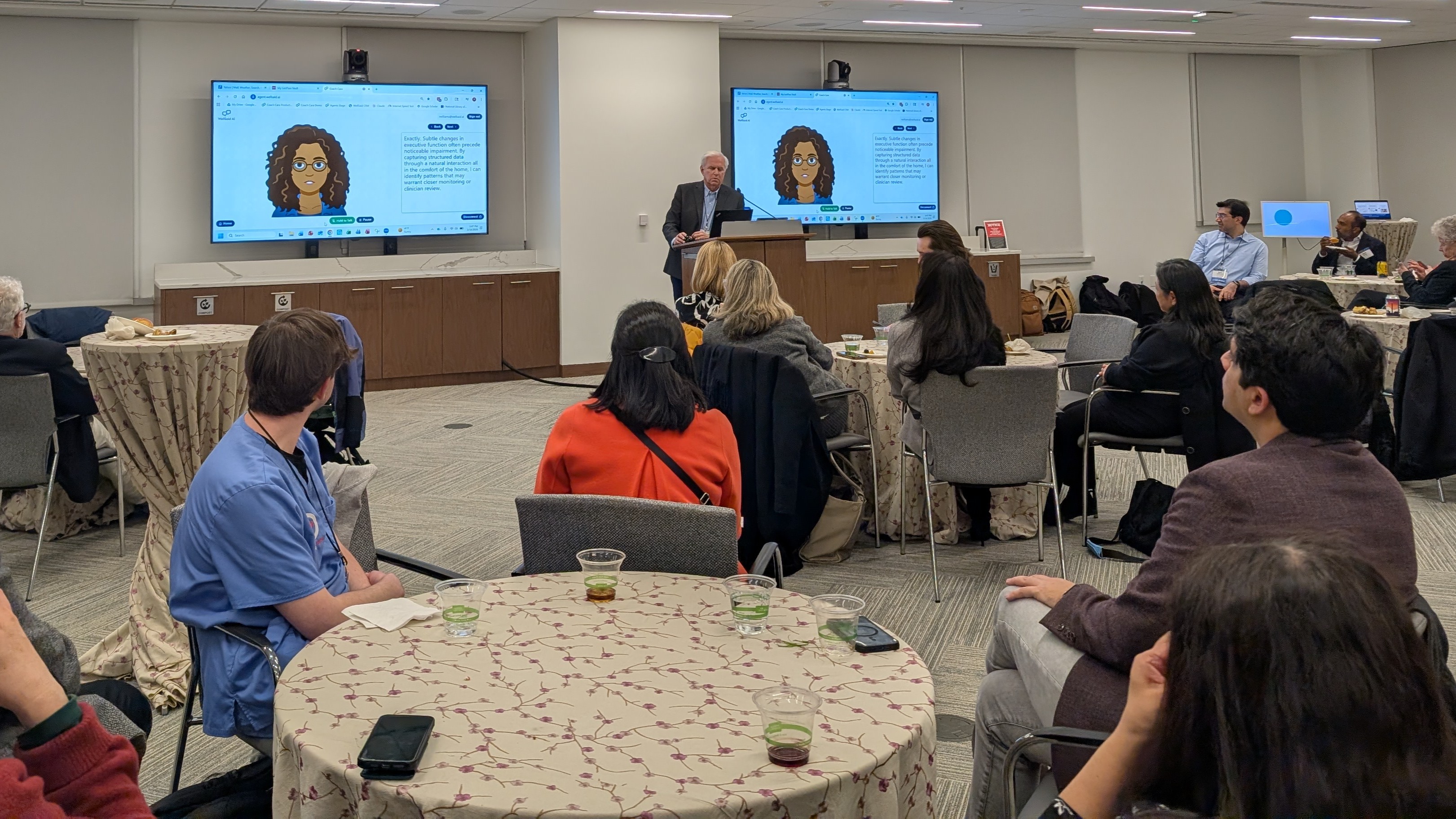
Following the workshops, participants attended a reception hosted by the AgeTech CollaborativeTM from AARP at the AARP National Headquarters, which connected current a2 pilot awardees with innovators who belong to both the a2 Pilot Awards and AgeTech Collaborative ecosystems. The reception featured welcome remarks from Amelia Hay, MBA, AgeTech Collaborative from AARP, and technology demonstrations by Anna Barnacka, PhD, MindMics; Desh Mohan, MD, Koda Health; Kyle Rand, Rendever; and Randall Williams, MD, WellSaid AI.
NIA is one of 27 Institutes and Centers of the National Institutes of Health at the U.S. Department of Health and Human Services. The a2 Collective is funded through NIA grants U24AG073094 (the a2 Collective Coordinating Center), P30AG073104 (JH AITC), P30AG073105 (PennAITech), and P30AG073107 (MassAITC).
The full 2026 a2 National Symposium agenda and recap, along with upcoming events, additional resources, and other information, is available online. You can also follow the a2 Collective’s work on LinkedIn.