Since the National Institute on Aging (NIA) launched the Artificial Intelligence and Technology Collaboratories (AITC) for Aging Research program in September 2021, the program has dedicated more than $40M to AI and technology development projects that aim to improve the lives of older adults, including those with Alzheimer’s disease and related dementias, and their caregivers. Operating as the a2 Collective, the program’s three AITCs—centered at Johns Hopkins University (JH AITC), the University of Massachusetts Amherst (MassAITC), and the University of Pennsylvania (PennAITech)—and the AITC Coordinating Center managed by Rose Li and Associates Inc., have fostered innovation through nondilutive funding, mentorship, and commercialization support for technologists working across research universities, healthcare institutions, and industry. The AITC research program, including a2 Pilot Awards funding and support, may stimulate collaboration within the AgeTech field. Bibliometric social network analysis (SNA) can assess this influence by mapping and comparing awardees’ co-authorship networks before and after award receipt.
A pilot SNA of a2 Pilot Awards Cohort 2 (funded in 2023)1 assessed how participation in the a2 Collective affected the collaborative reach of AI and AgeTech researchers funded in this cohort. The study demonstrated the feasibility of using SNA to measure the a2 Collective’s impact on the AI and AgeTech research ecosystem. A pre-post comparison of institutional collaborations via co-authorships across published research papers published by all 49 Cohort 2 principal investigators (PIs) and multiple principal investigators (MPIs) suggests that the a2 Collective has expanded institutional participation in the AI and AgeTech field.2 This analysis represents collaborations across all institutions included in the network, and a subset focused on collaborations across the three AITCs: JH AITC, MassAITC, and PennAITech.
Pilot Case - Analysis Snapshot
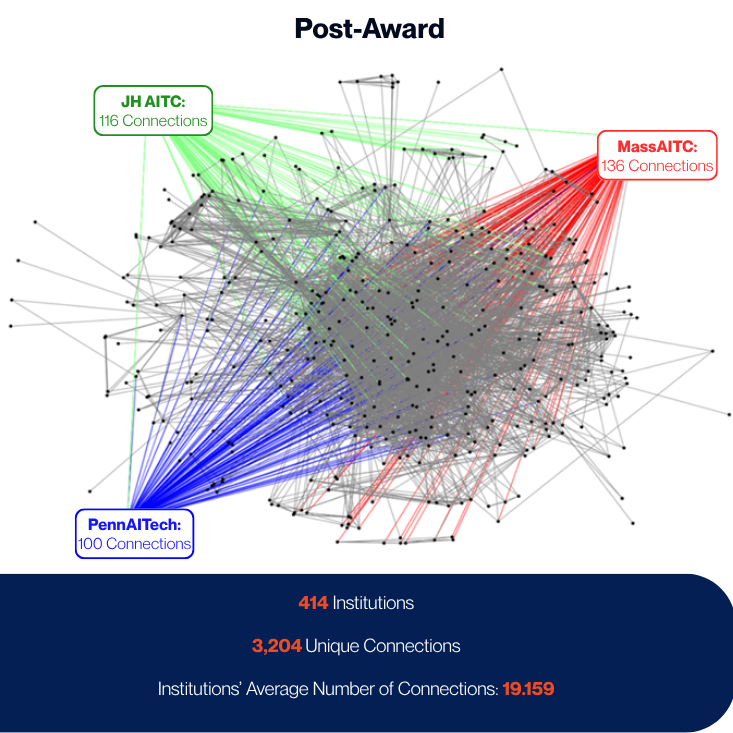
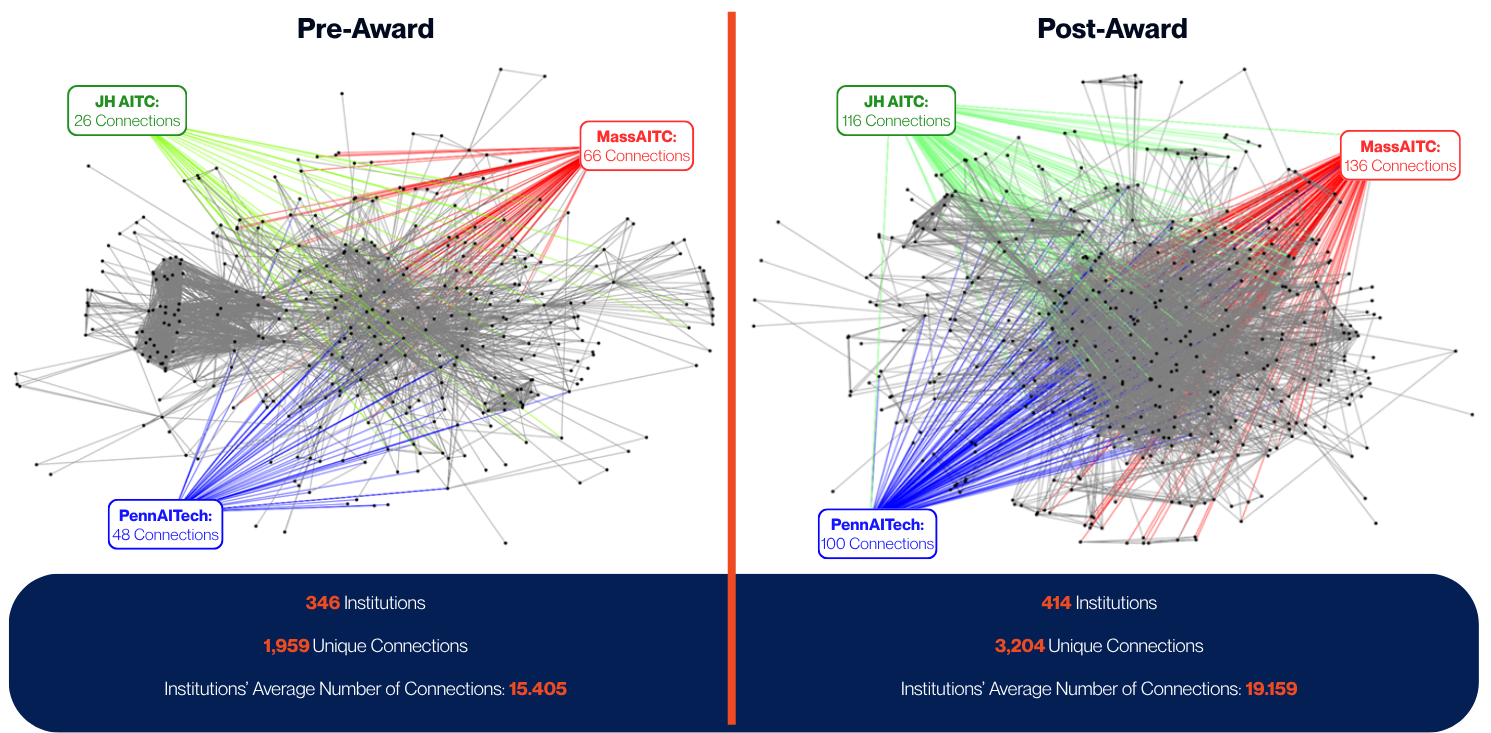
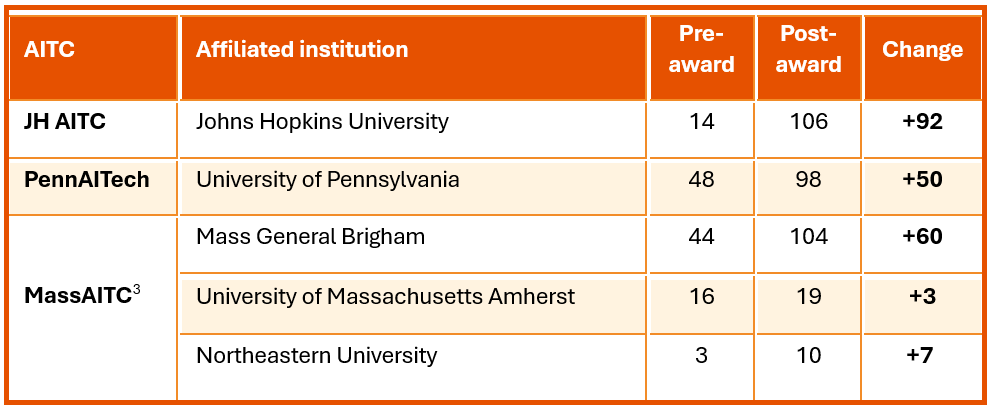
Across the network of all Cohort 2 PIs/MPIs and collaborating institutions, there was a 19.7% increase in the number of institutional authors in the 2-year period following receipt of a2 Pilot Awards funding (Figure 1). The number of unique connections, or the number of institutional pairs that published at least one research article together, experienced a more dramatic increase of 63.55%. These results indicate that this segment of the AgeTech research community published research with more institutions, suggesting increased research collaboration, after receiving a2 Pilot Awards funding. The increase in connections from all three AITCs demonstrates notable growth in connectivity, reflecting strengthened collaborative patterns, as illustrated in Figure 1 (below), and in Table 1, which lists the number of connections each AITC institution had within the awardee network pre- and post-award.
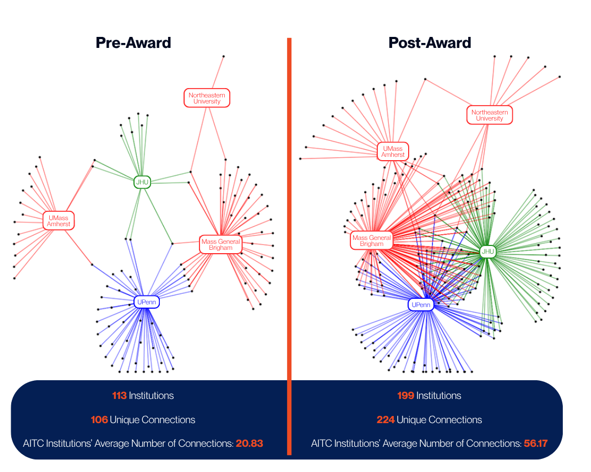
A sub-analysis mapped collaboration including the AITC institutions (Figure 2) to assess inter- and intra-AITC institutional collaboration activity. On average, the number of connections per AITC institution increased by 169% in the 2 years following the Cohort 2 awards, despite the total number of network institutions increasing by 76.1%. These results suggest that participation in the AITC program increased the density of research collaborations (i.e., the institutions were more likely to publish research with a higher percentage of institutions within the network).
This SNA pilot demonstrated the feasibility of using SNA to measure the effect of the a2 Pilot Awards program on institutional collaboration and yielded initial insights on the a2 Collective’s impact. The members of a2 Pilot Awards Cohort 2 were more collaborative, in terms of publishing research together, in the 2-year period following award than in the 2 years prior. Interestingly, AITC institutions also experienced an increase in connections between the pre- and post-award award periods compared to non-AITC institutions on average, suggesting that participation in the AITC program promoted collaboration with the affiliated institutions.
Several limitations should be considered when interpreting the findings of this SNA pilot. First, the reliance on publication data to measure collaboration may underrepresent awardees from startup companies and for-profit organizations, as they tend to publish less often than those from academic institutions—publication co-authorship is only one avenue for research collaboration. This dataset included all publications from Cohort 2 PIs/MPIs, regardless of their relevance to the AI and AgeTech field. Future analysis could incorporate publication key terms alongside the institutional co-authorship mapping to assess whether a2 Pilot Awards funding introduced new researchers and institutions to the AgeTech field. Future analysis could also examine the attributes of “super connectors,” or institutions with a disproportionately high number of connections, to characterize their approaches to stimulate collaboration. The ability of the pilot SNA to measure the a2 Pilot Awards program’s impact on research collaboration suggests that this framework could be adapted to measure the impact of other National Institutes of Health–funded networks and coordinating centers.
NIA is one of 27 Institutes and Centers of the National Institutes of Health at the U.S. Department of Health and Human Services. The a2 Collective is funded through NIA grants U24AG073094 (the a2 Collective Coordinating Center), P30AG073104 (JH AITC), P30AG073105 (PennAITech), and P30AG073107 (MassAITC).
Notes
1. Cohort 2 was the most recent a2 Pilot Awards cohort for which publication data could be retrieved for 2 years before and after the average project start date.
2. Research publications were captured within a 2-year window before and after the average Cohort 2 project start date (September 1, 2023). Narrative reviews, commentaries, and perspective articles were not included.
3. MassAITC consortium member Brandeis University is not included within this table as it was not included as an institutional author in any research publications within the dataset.
References
Aboelela, S.W., Merrill, J.A., Carley, K.M., & Larson, E. (2007). Social network analysis to evaluate an interdisciplinary research center. J. Research Administration, 38(1). https://files.eric.ed.gov/fulltext/EJ902219.pdf
Huffman, D.R., Bruns, C.J., Neff, P.D., & Roop, H.A. (2025). Social network analysis to understand participant engagement in transdisciplinary team science: a large U.S. Science and Technology Center case study. Humanities and Social Sciences Communications, 12(405). https://doi.org/10.1057/s41599-025-04677-3
Zhang, Y., & Zic, B. (2021). Applying Social Network Analysis to Examine Program Output and Impact [White paper]. Manhattan Strategy Group. https://manhattanstrategy.com/sites/default/files/2022-11/WhitePaperSocialNetwork.pdf