a2 Pilot Awards Fifth Annual Competition (2025)
Request for Applications (RFA)
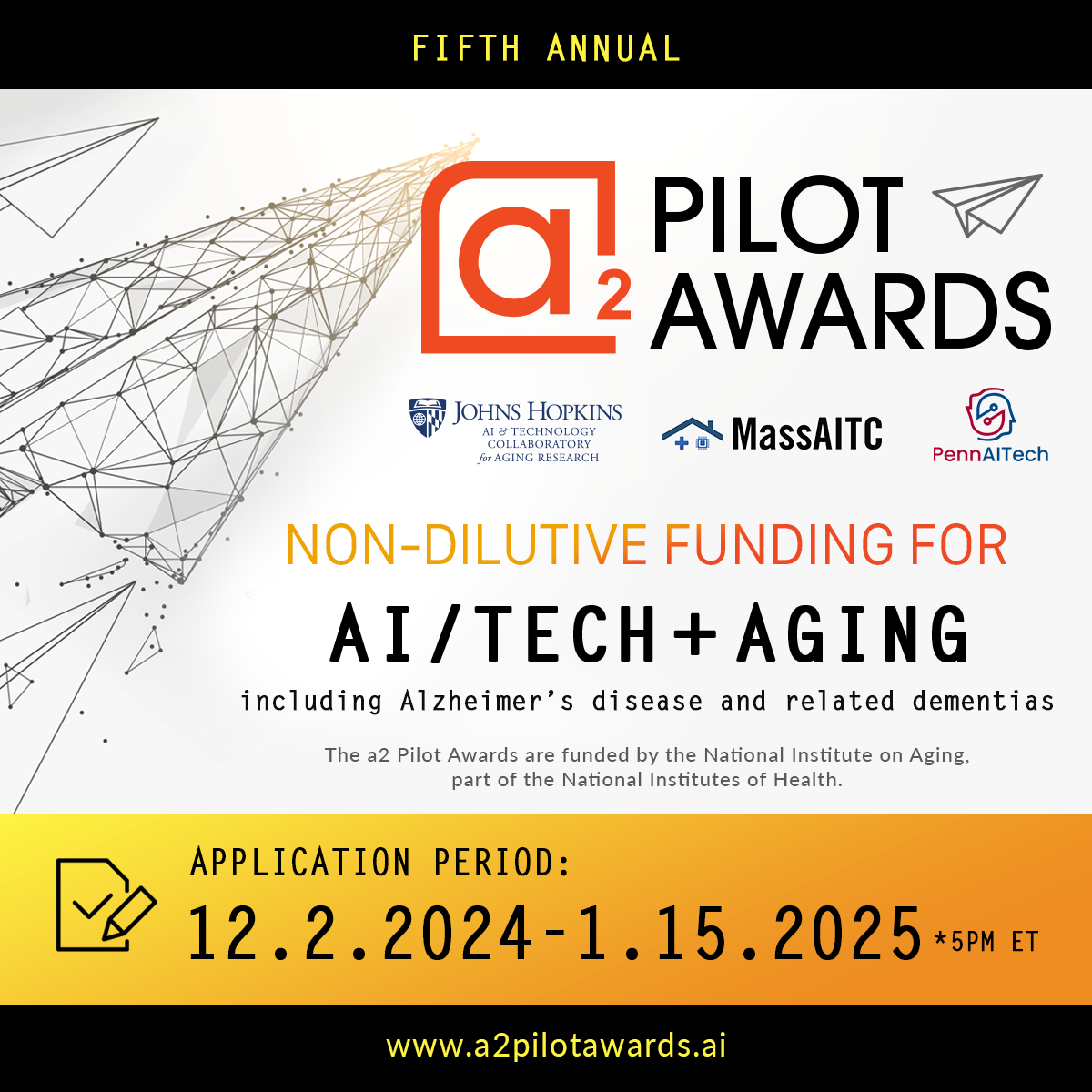
Round 1 Application Period: Dec. 2, 2024–Jan. 15, 2025 (5 p.m. ET)
The a2 Collective is pleased to announce the fifth annual a2 Pilot Awards competition to fund promising technology demonstration projects with a clear path to commercialization, translational milestones, or technology transfer at the intersection of artificial intelligence (AI), healthy aging, and Alzheimer’s disease and related dementias (AD/ADRD). Launched by the National Institute on Aging (NIA), part of the National Institutes of Health (NIH), the Artificial Intelligence and Technology Collaboratories (AITC) for Aging Research program—or a2 Collective—is dedicated to helping Americans live longer, healthier lives through the application of AI and emerging technologies. The a2 Collective comprises three collaboratories centered at Johns Hopkins University (JH AITC), the University of Massachusetts Amherst (MassAITC), and the University of Pennsylvania (PennAITech), as well as the a2 Collective Coordinating Center managed by Rose Li & Associates, Inc. (RLA).
Scope
The a2 Pilot Awards fund projects that leverage cutting-edge technology and AI-based approaches to improve the care, health outcomes, and quality of life of older adults, including those with AD/ADRD, and their caregivers. Projects should focus on the development of novel technology or on novel combinations or adaptations of existing technology with clear potential for commercialization or translational impact. In addition to technology development and adaptation, a2 Pilot Awards can support feasibility and user testing to further the development of the technology, particularly of technologies that are intended to be deployed in residential settings or to enable older adults to age in place.
In the fifth annual a2 Pilot Awards competition (2025), funds will not be awarded to project applications that (1) focus on market research (e.g., focus groups, surveys), (2) focus on drug discovery, development, or target identification beyond bioinformatic-based approaches, (3) include any component that constitutes a clinical trial as defined by NIH, or (4) propose either incremental enhancements or new indications/patient populations for technologies/platforms that have been supported by NIH Small Business Innovation Research (SBIR) or Small Business Technology Transfer (STTR) funding.
Topics of Interest
a2 Pilot Awards fund a wide range of technologies, including home monitoring sensors and systems, clinical decision making and diagnostic tools, virtual reality platforms and conversational companions, and algorithms that predict outcomes for older adults and caregivers alike. A list of select research areas of interest is provided below; however, applicants are strongly encouraged to review individual AITC requests for applications (RFAs), as the below list is not comprehensive and emphases can vary across AITCs.
Broad areas of interest in the fifth annual a2 Pilot Awards competition include:
• Computational biology and multi-scale data analysis for insights into aging- and AD/ADRD-related vulnerability, resilience, and progression—see Appendix for additional parameters applicable to this topic area
• Sensors, smart devices, and software to promote safe, independent aging in place and improve access to care and resources
• Analytic approaches to identify disparities, detect risk, and predict needs at both population and individual levels, including through electronic health record integration
• Tools for clinicians and caregivers to enhance decision making, diagnosis, and workflows
• Integrated platforms to enhance care coordination and communication
• Data analytic and visualization solutions to distill large volumes of multi-modal data into interpretable and actionable information for older adults, caregivers, and clinicians
• User-facing devices and platforms to promote physical, cognitive, social, emotional, and financial well-being for older adults and their caregivers
Prospective applicants should visit the three AITC websites to review their individual RFAs, which include additional details on project scope and example project topics.
Eligibility
Fiscally responsible organizations including for-profit corporations and startups, colleges, universities, medical or nursing schools, health care systems or settings, nonprofits, and eligible government entities within the United States are eligible to apply. Applications that propose either incremental enhancements or new indications/patient populations for NIH SBIR/STTR-funded technologies/platforms are not eligible for funding in the fifth annual a2 Pilot Awards competition (note this restriction does not apply to non-NIH SBIR/STTR awards).
Eligible institutions must have a Unique Entity ID (UEI). Non-domestic (non-U.S.) entities and non-domestic (non-U.S.) components of U.S. organizations are not eligible to apply. Foreign components, as defined in the NIH Grants Policy Statement, are allowed with NIH foreign clearance.
Program Structure and AITC Selection
a2 Pilot Awards accelerate innovation by providing funding, AITC expert oversight and potential collaboration, and enhanced opportunity for future funding and partnerships. All three AITCs are multidisciplinary research centers that can provide access to research translation support; state-of-the-art facilities; and resources including software and hardware platforms, datasets, and population study sites. Each AITC supports projects in the areas of healthy aging and AD/ADRD. Based on project focus, each awarded pilot will be funded as a subaward to one of the three AITC institutions. Applicants must specify their primary AITC choice and are encouraged to visit AITC websites prior to applying to learn more about each collaboratory’s emphases, team, and resources. If the selected AITC declines to advance an application for further consideration, it can release the application for consideration by the other AITCs. Applicants may propose multiple unique pilot projects within the same competition by submitting a separate application for each project. Simultaneous submission of substantively similar or overlapping pilot projects in a single competition cycle, whether to one AITC or to multiple AITCs, is not permitted. Violation of this policy will result in disqualification of one or more of the submitted applications.
Project Period and Budget
Projects will be funded for a 12-month period, beginning in fall 2025. Most funded project budgets will not exceed $100,000 in direct costs, plus facilities and administrative (F&A) costs, but higher levels of funding (i.e., up to $200,000 in direct costs) will also be considered with appropriate justification. Larger projects supported by multiple AITCs are possible; however, multi-AITC applications will only be considered if all AITCs from which support is requested have been consulted and provided preliminary approval prior to submission. Pilot grant funds may be used for (1) project support of personnel; (2) use of services, including, where applicable, salary support for investigators, biostatisticians, staff, or other experts; (3) project-necessary travel, including to the a2 National Symposium; (4) equipment, research supplies and reagents, and lab costs; (5) study participant compensation; (6) other study-related expenses with justification; and (7) publication costs. If proposed pilot projects will leverage other funds or in-kind support, applicants are encouraged to provide a short explanation of how the proposed pilot project and other support will complement one another.
Indirect Costs Policy: F&A rates that have been established in a current federally negotiated F&A rate agreement may cover applicable indirect costs during the project’s approved period of performance. Applicants without federally established F&A rates are entitled to a de minimis 10 percent indirect rate. Small business applicants should note that SBIR/STTR policies and rates do not apply to this program.
Award Approval and Disbursement of Funds
Funding is contingent on NIA approval, IRB approval (if human subjects are involved), and, if applicable, foreign clearance by the U.S. State Department. The anticipated formal award date is subject to change based on these factors. Please note that this program operates on a reimbursement basis. Project teams will invoice for expenses incurred on a schedule set by their AITC (e.g., quarterly or monthly). Funds will not be available as a lump sum disbursement and applicants selected for award should not incur costs for which they expect AITC reimbursement until a subaward agreement with the AITC’s institution has been executed.
Other Requirements
Funded projects’ principal investigators (PIs) are expected to engage in ongoing mentoring and oversight within individual AITCs, attend and present their project at the annual a2 National Symposium, and adhere to the a2 Collective Data and Resource Sharing Plan. Awardees are encouraged to take an active role in the AITC community, such as by attending meetings and events, participating in online discussions, and amplifying future a2 Pilot Awards competitions.
Evaluation Criteria
All AITCs will use the same application process and general evaluation criteria, which are available in full as Applicant Resources. Pilot projects will be evaluated based on factors including the project’s significance, innovation, approach including treatment of representation and bias, commercialization potential, and proposed investigators and environment. Additional consideration may be given to projects that leverage an AITC’s resources or facilities or generate datasets, software, or hardware that might benefit the AITC research community at large. Other priority areas of consideration include go-to-market strategy, regulatory and reimbursement pathways, plans for managing human subjects and data privacy risks, and mitigation of health disparities across the United States, including improving access to and delivery of care in rural areas.
Application Process
The a2 Collective welcomes applications from those who applied to previous a2 Pilot Awards competitions as well as first-time applicants. The fifth annual a2 Pilot Awards competition includes a mandatory Round 1 application for all applicants and a more detailed Round 2 application for a subset of applicants who are invited to submit additional materials. Details on the Round 1 and Round 2 application requirements are included below, and sample blank application forms are available as Applicant Resources.
Round 1 Application: To be considered for invitation to Round 2, please submit a Round 1 application here (application link open Dec. 2, 2024–Jan. 15, 2025). Round 1 applicants will submit a 2-page project statement that includes the following elements:
• Overview of the pilot project’s scientific approach
• Overview of the project’s AI/technology approach
• Description of how the project is relevant to healthy aging and/or AD/ADRD
• Project aims and expected outcomes
• Explanation of plans or potential for commercialization of project deliverables
Round 1 applicants will also be asked to report any scientific, budgetary, or commitment overlap with other funding sources; specify the project’s primary clinical/behavioral health domain, specific needs to be addressed, and AI or technology approaches to be leveraged; and provide estimated direct costs for the project, award numbers for any prior federal funding that has supported the project, a list of key personnel, an NIH biosketch for the project PI(s), information about potential conflicts of interest (COIs) relevant to any of the AITCs, human subjects and research exemptions information, and optional demographic information.
Round 2 Application: Those invited to submit a Round 2 application will provide the following:
• Any emergent scientific, budgetary, or commitment overlap with other funding sources
• Completed a2 Collective Data and Resource Sharing Plan Agreement
• Project relevance to the selected AITC and description of any AITC resources the project will access
• Potential COIs relevant to any of the AITCs
• Specific aims, including objectives and benchmarks to measure success (1-page limit)
• Research strategy including project significance, innovation, approach, and known limitations (3-page limit)
• Discussion of the project’s ethical considerations
• Detailed budget (template and instructions provided)
• Budget justification (example provided)
• Key personnel and other significant contributors
• Biosketches for key personnel (template and example provided)
• Project performance site(s)
• Human subjects and research exemptions information
During Round 2, applicants may also submit optional letters of support and citations.
Deadlines and Anticipated Timeline
• Round 1 applications due by 5 p.m. ET on Wednesday, Jan. 15, 2025
• Round 1 application decisions expected to be made by Wednesday, Feb. 19, 2025
• Round 2 applications due by 5 p.m. ET on Monday, March 31, 2025
• Finalists expected to be named by mid-May 2025
• NIA approval of awards expected in summer 2025
• Projects expected to begin in fall 2025
Additional Information for Applicants
Prospective applicants are encouraged to register to attend a pre-application Q&A webinar with AITC leadership to be held on Monday, Dec. 9, 2024, from 12 to 1 p.m. ET. Visit a2pilotawards.ai for more information, including answers to frequently asked questions.
Additional inquiries may be directed to support@a2collective.ai.
Appendix: Additional Parameters for Pilot Applications Focusing on Biological Underpinnings of Physical and Cognitive Decline in Aging and AD/ADRD
Introduction
In an era when artificial intelligence (AI) and technological innovations are revolutionizing the way we understand the world, the AI & Technology Collaboratories (AITC) for Aging Research program, or a2 Collective, is seeking pilot applications focused on harnessing these advancements to explore the complexities of aging and Alzheimer's disease and related dementias (AD/ADRD). With a surge in computational capabilities and the aggregation of vast datasets, there exists an unprecedented opportunity to accelerate our understanding of these phenomena from an AI-first perspective.
Objective
The a2 Collective aims to fund projects that utilize cutting-edge AI and machine learning technologies to build computational models that can simulate the multifaceted dynamics of aging and AD/ADRD. By applying AI to bridge gaps across various biological scales and temporal dimensions, these projects will pave the way for breakthroughs in predicting, understanding, and possibly intervening in aging processes and neurodegenerative diseases.
Focus Areas
We are particularly interested in proposals that:
• Employ advanced AI, machine learning, and computational modeling techniques to study aging and AD/ADRD
• Integrate multi-scale data analysis, from genomic to phenotypic levels, to uncover novel insights into the aging process and AD/ADRD disease progression
• Propose innovative methods for analyzing datasets that contain molecular and longitudinal phenotypical data to identify patterns of age-related vulnerability and resilience
• Aim to validate computational models through rigorous hypothesis testing and real-world data correlation
Suggested Research Themes
Projects may explore, but are not limited to, the following areas:
• Development of AI-driven biological "clocks" to predict physical and cognitive decline in aging and disease markers
• Investigation of hallmarks of aging (e.g., mitochondrial dysfunction, cellular senescence, genomic instability, telomere attrition, epigenetic alterations, deregulated nutrient sensing, altered intercellular communication) through machine learning analyses
• AI models to predict the impact of metabolic and energetic changes on aging
• Patient subtyping from molecular data
• Temporal AI/ML models of phenotype and molecular changes during aging to compare patients to baseline and identify premature aging or outlier behavior
• Computational studies of synaptic function and its effects on aging cognition and mobility
• Utilization of AI in analyzing interventions aimed at promoting healthy aging practices
Eligibility and Requirements
To foster innovation and ensure impactful outcomes, all submitted projects must:
• Clearly articulate the use of AI and machine learning technologies as core components of the research strategy
• Confirm existing data access or outline a clear plan for accessing available data sources such as UK Biobank, GTEx, or other large resources in time for the project period
• Demonstrate a direct relevance to aging or AD/ADRD research fields
• Propose a clear, testable hypothesis, a predictive model, or clear use of computational method
Nonresponsive Proposals
Applications lacking a strong AI and technology focus, or those not addressing aging or AD/ADRD relevance, will be considered nonresponsive and thus ineligible for funding.
a2 Pilot Awards Competition Information
Applications focusing on biological underpinnings of physical and cognitive decline in aging and AD/ADRD are subject to the parameters described in the base request for applications to the fifth annual a2 Pilot Awards competition, in addition to guidance provided in this appendix.
The a2 Collective is funded through NIA grants U24AG073094, P30AG073104, P30AG073105, and P30AG073107.